

Lead Generation

Google Ads for Dental Clinics – How to Get More Patients in 2026
Hello Doctor!If you’re here, you’re not just exploring Google Ads. You’re looking for real, result-driven Google Ads strategies to increase
Hello Doctor!
If you’re here, you’re not just exploring Google Ads. You’re looking for real, result-driven Google Ads strategies to increase patient bookings and scale your dental revenue. You’re also here because you want real patients walking into your clinic, not vanity clicks or empty impressions through Google Ads.
Imagine your front desk hearing “Can I book a slot today?” on loop, the best part of your day. That’s what we do at BeOnAds. We’ve partnered with over 200 dental clinics across the USA to turn Google Ads into a predictable stream of patients. For us, dental marketing isn’t just a theory we’re testing; it’s muscle memory. We know exactly which keywords bring patients through the door and which ones just burn through your budget.
The reality of the market in 2026 is that simple keyword targeting isn’t enough anymore. To win, you have to leverage AI-powered bidding, obsess over high-intent local signals, and send traffic to high-converting landing pages rather than generic homepages. It requires bulletproof tracking and constant optimization to stay ahead of the clinic down the street.
Let’s be honest: you’re a dentist, not a full-time ads manager. That’s where we come in. We don’t just ‘run ads’; we build patient-acquisition systems. Our goal is to turn search intent into confirmed appointments and measurable ROI, so you can focus entirely on clinical excellence while we handle the growth engine. If you’re ready for expert support, you can explore our Google Ads Management Service .
Let’s explore in greater detail the precise methods for maximizing patient flow and return on investment (ROI) by utilizing Google Ads effectively.
Imagine you are the patient and you suddenly experience severe tooth pain, or a tooth breaks out of nowhere, and the pain becomes unbearable. What’s the very first thing you do? You pull out your phone and search “emergency dentist near me.” You don’t scroll social media, you don’t ask around; you go straight to Google. That’s exactly why Google Ads works so well for dental clinics.
Google Search Statistics
As of 2025, before choosing a dentist, 93% of patients do online research. 87% of patients use Google as their main research source, making it the “new front door” for many.
Unlike social media, where people scroll to be entertained, Google Ads shows your clinic exactly when someone is searching for a dentist. These are patients with pain, urgency, or a clear need, and that’s why Google Ads is one of the fastest ways to grow a dental practice. You have the control to show your dental clinic with the right strategy at the right moment someone is searching to get “emergency dental appointment”, patient is in pain, and just imagine if you can be on top of “dentist near me” results on SERP, boom! You got the lead. That’s exactly what we do by the way. Ok, now, let’s understand
The process is a refined cycle of Intent, Click, and Convert. First, we identify high-value search terms, like “dental implants near me” or “emergency dentist” – ensuring your clinic appears at the very top of Google’s search results.
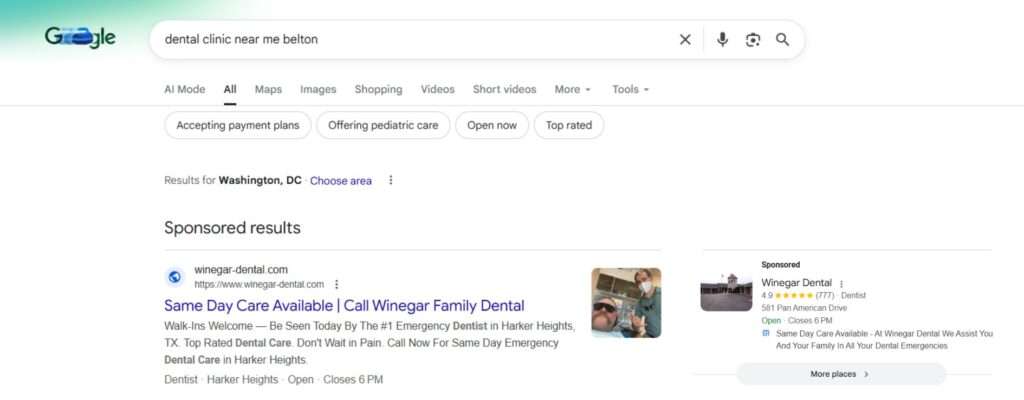
Dental Care Search Ads – Google SERP
When a resident clicks, they aren’t sent to a cluttered homepage; they land on a streamlined, high-speed page designed specifically to get them to call your office or book an appointment. Google’s AI then “learns” from every successful booking, automatically refining your reach to find more patients with similar needs.
In 2026, the “Yellow Pages” are long dead, and social media is often too passive for medical needs. When someone has a toothache or is finally ready for those veneers, they don’t scroll Instagram; they go to Google. Google Ads is the only platform that allows you to intercept a patient at the exact moment of high-intent decision-making. While other marketing channels “push” messages at people who might not be interested, Google Ads “pulls” in people who are already standing at your digital front door with their credit cards ready.
Statistics show that 65% of high-intent searches result in an ad click. This is because Google’s sophisticated AI now understands the difference between someone researching “how many teeth do humans have” and someone searching for “cost of dental implants”
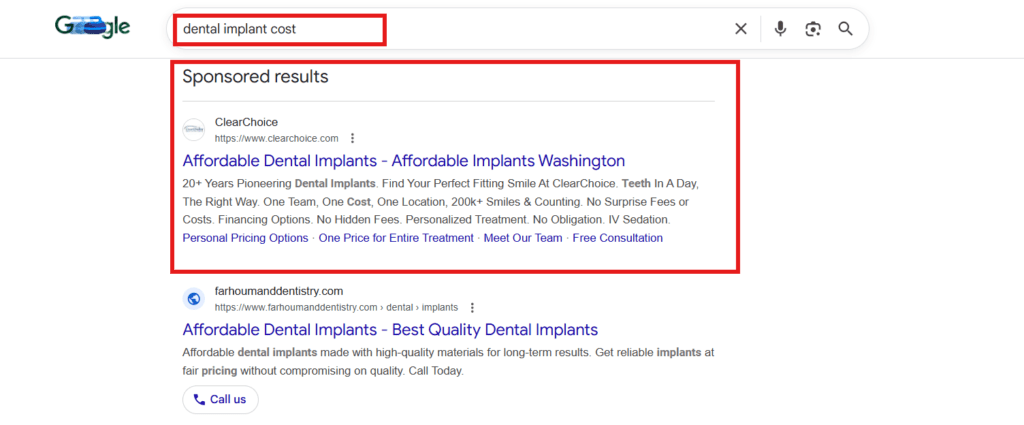
Google Sponsored Search Ads – Dental Implants
By bidding on these “buying keywords,” your clinic skips the awareness phase and moves straight to the conversion. You aren’t just buying traffic; you are buying an audience that has already decided they need a dentist today.
The phrase “Dentist Near Me” has seen a 500% increase in search volume over recent years. More importantly, emergency dental searches are almost exclusively mobile-driven.
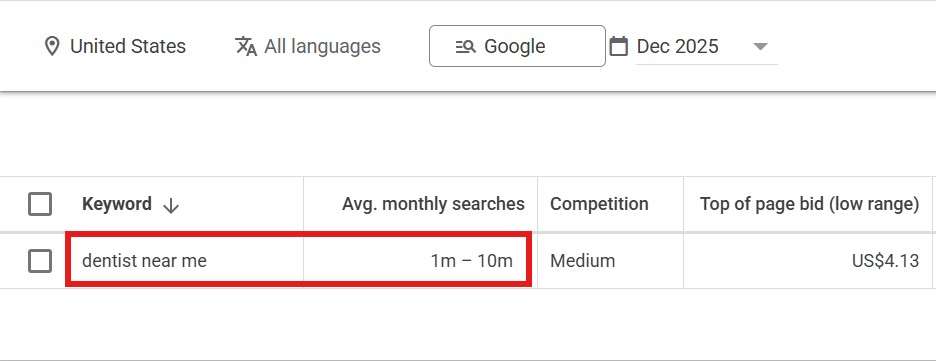
When a resident experiences a dental emergency, they click the first “Call” button they see. Google Ads lets you dominate the “Local Pack” and the top of mobile search results. Because 75% of users never scroll past the first page, being in that top slot for an emergency search isn’t just a luxury; it’s the difference between your office getting the call or the clinic two blocks over.

We help businesses scale smarter, faster, and profitably through strategic & data-driven advertising across the world’s biggest platforms.


The dental market is hyper-local. Most patients are unwilling to travel more than 5 to 10 miles for a routine appointment. Google Ads gives you a “digital billboard” that only appears to people within your specific catchment area.
Even if a competitor has been in the neighbourhood for 30 years and dominates the organic (SEO) rankings, Google Ads lets you leapfrog them. Paid ads appear above organic listings, meaning your name is the first thing a patient sees, effectively neutralizing the “seniority” of older practices in your area.
Search Engine Optimization (SEO) is a marathon; it can take 6 to 12 months to see a significant move in rankings. While SEO is a vital long-term play, most clinics can’t afford to wait half a year for their phone to ring. Google Ads is a sprint. You can launch a campaign in the morning and start receiving new patient inquiries by the afternoon.
There are numerous varieties of Google ads available for you to explore, but determining the best ad type for your dental clinic is crucial. According to the latest trends in dental marketing for 2025–2026, the most commonly used and effective Google Ads for dental clinics emphasize searches that indicate high intent and immediate needs. These campaigns are specifically localized to reach patients located within a 5–10 mile range from the clinic.
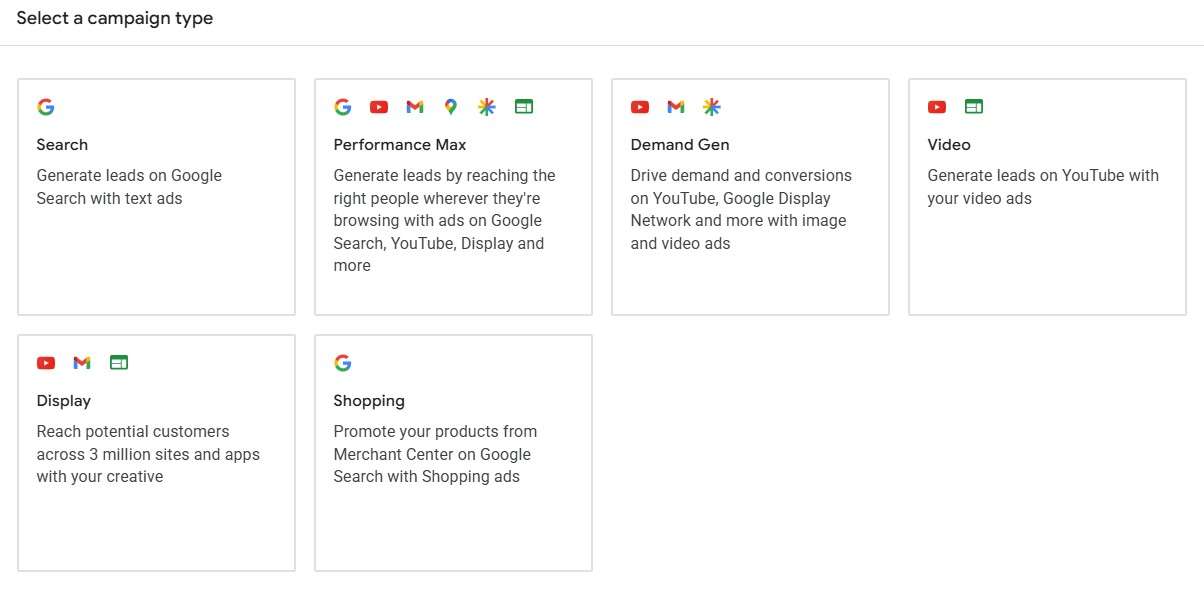
Types of Google Ads
Google Responsive Search Ads are the most powerful ad types in Google Ads because you have full control over them: what to show to the user, how to show it, how to target, whom to target, and even when to show them.
Isn’t it interesting? Let’s go deeper into Google search ads. But if you’d prefer expert support, we can create result-driven Google search campaigns for your dental clinic. Sign up for a 7-Day Free Trial.
Search Ads are the backbone of Google Ads for dental clinics because they capture high-intent patients, people who are actively looking for a dentist right now. These aren’t people scrolling for entertainment; they are people in pain, in a hurry, or ready to book. Search Ads work best for services like emergency dentistry, implants, Invisalign, cosmetic treatments, and new patient exams because the intent is already there. If someone is typing a query, they are already halfway to becoming your patient.
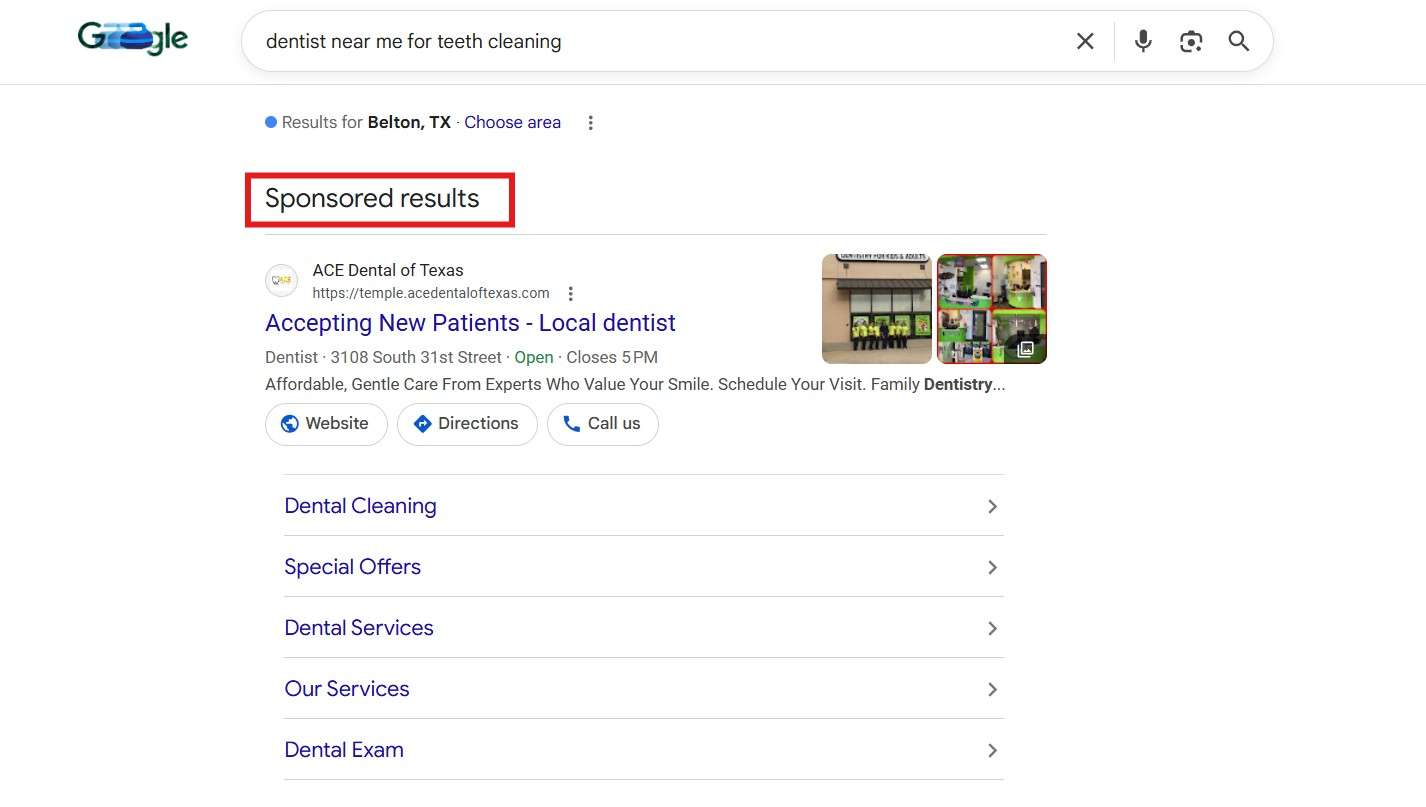
Image Source – Google
In 2026, Google’s algorithm rewards relevance and user experience. If your ad is vague, your cost-per-click (CPC) goes up, and your patient bookings go down. Here is the step-by-step framework for building a result-driven search ad for your clinic.
Let’s say your dental clinic offers General Dentistry and Emergency Dental Care; services like teeth cleaning, tooth extraction, pain relief, and urgent treatments. The first step is to choose keywords based on what people are actually searching for in your local area or city.
Once you have your keyword list, don’t throw everything into one campaign. Instead, organize them into clear groups. Start with two main categories:
But it doesn’t stop there. Each of these categories should be split into two sub-groups:
So in simple terms, for every service category, you create: One group for generic searches, and
One group for city or location-based searches.
This structure keeps your ads highly relevant, improves your Quality Score, and usually lowers your cost per lead while bringing in better-quality patients. Now, check the image below to see exactly how your keyword structure should look in a real Google Ads account.
At BeOnAds, we have extensive data on the keywords that have successfully generated results for over 200 dental clients. We can help you achieve similar success! Book a strategy call with us and sign up for a 7-day free trial.
Once your keyword structure is clear, the next step is to set up your Google Ads search campaigns for your dental clinic in a way that keeps control, improves relevance, and lowers your cost per lead. Start by creating separate campaigns for each main service category, for example, one campaign for General Dentistry and another for Emergency Dentistry. This separation is important because the intent, urgency, and bidding strategy for these two types of patients are completely different.
Inside each campaign, create different ad groups based on keyword themes. For example, in the General Dentistry campaign, you can have ad groups like Veneers, Teeth Cleaning, and Family Dentistry. Each of these should again be split into generic keywords and city-based keywords. The same structure should be followed for the Emergency Dentistry campaign, with ad groups like Emergency Dentist, Tooth Extraction Emergency, and 24-Hour Dental Care.
This kind of structure ensures that your ads match exactly what the patient is searching for. When someone searches “veneers dentist in Miami,” they should see an ad that talks specifically about veneers in Miami, not a generic dental ad. This improves your Quality Score, increases click-through rate, and usually reduces your cost per click and cost per lead.
Next, write service-specific ad copies for each ad group. Your emergency ads should focus on urgency, same-day appointments, and fast relief. Your general dentistry ads should focus on comfort, trust, experience, and long-term care. The more relevant your ad is to the search, the better Google rewards you with cheaper and better traffic.
Finally, connect each ad group to a dedicated landing page that matches the service being searched. Emergency ads should go to an emergency page. General ads should go to a General dentistry page. Now you are all set.
Call-Only Ads have one basic goal: to make your phone ring. Instead of directing visitors to your website, these ads appear on mobile devices and allow patients to call your clinic directly with a simple swipe. This structure works exceptionally well for dental clinics because most high-intent patients, particularly those who are searching for “emergency dentist near me”, do not want to read pages or fill out paperwork. They want to speak with a dentist or receptionist right now.
Creating Call-Only Ads for your dental clinic is very similar to setting up a normal Google Search campaign. The main difference is that instead of using Responsive Search Ads that send users to your website, you create a Call-Only ad that lets patients call your clinic directly by tapping on the ad. In this setup, you simply add your phone number and a final URL (for verification), and Google shows your ad primarily to mobile users who can make calls.
That said, based on our experience helping 200+ dental clinics generate real patient leads, we usually recommend starting with Responsive Search Ads instead of relying only on Call-Only Ads. The reason is simple: Call-Only Ads require very tight, high-intent keywords, and because of this, the cost per click (CPC) is often higher. You also limit yourself to people who want to call immediately.
With Search Ads, you get the best of both worlds. You can still generate phone calls by adding a Call Asset to your campaign, and you can push even more calls by using bid adjustments for mobile devices or call interactions. This approach usually brings more volume, better control, and a lower cost per lead compared to running Call-Only Ads alone.
Call-Only Ads work great for emergency and same-day appointment campaigns, but for most clinics, a smart mix of Search Ads + Call Assets delivers more consistent and scalable results.
Would you like to try BeOnAds for 7 days? Don’t worry; it’s completely free. Book a call now and see how we can turn Google Ads into a patient-generating machine for your clinic.
For the majority of dental offices, patients look for a dentist in their area rather than the “best dentist in the country.” This is the point at which local ads and Google Maps become extremely potent. When someone in your area is seeking dental care, these advertisements put your clinic right at the top of local search results and inside Google Maps.
Because proximity counts, local advertisements work particularly well for services like same-day appointments, emergency dentistry, and general exams. A patient’s decision is made much more quickly and easily when they see your clinic on a map with reviews, instructions, and a call button.
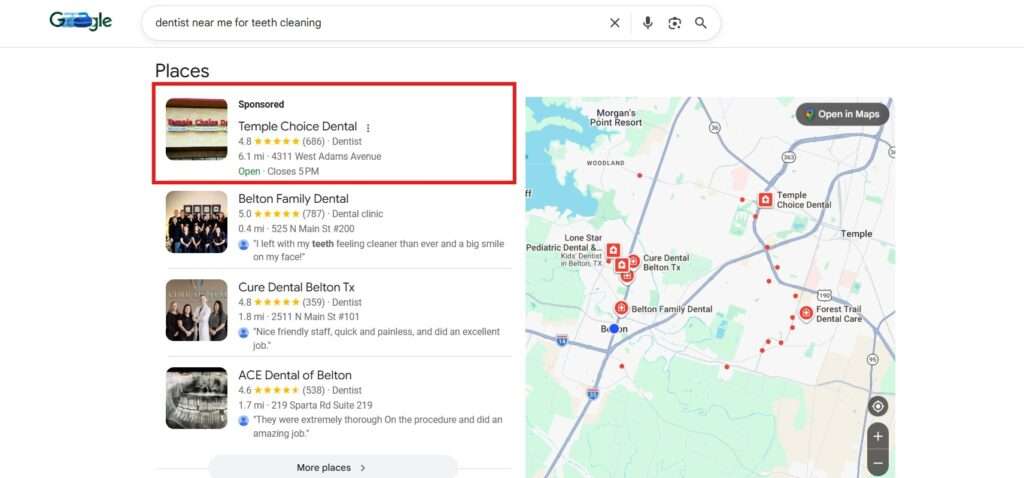
Make sure your Google Business Profile is validated and connected to your Google Ads account before creating Local Ads for Google Maps. Next, choose the location of your clinic, set your geo-targeting to your service region, and start a Performance Max campaign with a local store campaign objective. When local patients look for a dentist, Google will automatically display your advertisements on Google Maps and local search results. To get more calls, directions, and walk-in patients, it’s important to maintain an optimized profile with accurate information, reviews, and images.
Performance Max (PMax) is Google’s AI-driven campaign type that shows your ads across Search, Google Maps, Display, YouTube, Gmail, and Discover, from a single campaign. Instead of managing each channel separately, PMax uses automation and machine learning to find the best patients, on the best channel, at the right time.
We have helped our dental clients with result-driven PMax campaigns, and the strategy we have followed is Right Signals Only. PMax is not like a search campaign, it’s AI-drive,n but ye,s you can control the AI. Here is how?
Search Themes: Search themes in PMax is like keywords we use in a normal search campaign, but here there is no match type, so you just need to add broaden queries. Now, for example, for a search campaign, we can add the keyword “emergency dentist near me for tooth extraction” in phrase match, but when it comes to PMax, you can add only tooth extractio,n and Google’s AI will show your ads on searches related to tooth extraction. You can add upto 50 different search themes as keywords.
Audience Targeting: PMax is more likely to use Facebook ads where you can target the audience even by interest and behaviour. But if you ask us what the right targeting option you should choose for dental care marketing then you can create a custom audience with actual keywords you have researched from Google keywords planner. Additionally, you can target users who visit your competitors (other dental clinics) websites.
High-Quality Creatives: To create a PMax campaign, you need to add image assets (max 20), and if you design creatives with the right message or graphics, you will get remarkable results, your cost per lead will be profitable and the CPC is unbelievable. If your dental clinic is based in USA, we have seen as per our previous data, that you can get dental patient bookings at $20 if you have a well-optimised Pmax setup. Is it not interesting?
To create a PMax campaign, you start by selecting the “Leads” objective in Google Ads and choosing Performance Max as the campaign type. Then you add your conversion goals, such as phone calls, form submissions, or appointment bookings, upload your creative assets, like headlines, descriptions, images, logos, and videos, and connect your Google Business Profile so your clinic can appear in local and Maps placements. After setting your location targeting and choosing a bidding strategy like Maximize Conversions or Target CPA, you organize your asset groups around your main services, such as Emergency Dentistry, Implants, Invisalign, or Cosmetic Dentistry. The more accurate your tracking and the better your assets, the better Google’s AI can optimize performance.
Would you like us to set up result-driven PMax for your dental clinic? Book a call with BeOnAds and start your 7-Day Free Trial Now.
For dental clinics, the smartest use of Display and YouTube is remarketing. For example, if someone visited your implants or Invisalign page but didn’t book an appointment, you can show them follow-up ads reminding them about your clinic, your reviews, or your special offers. These audiences are already warm, so the cost per lead is usually lower compared to targeting completely cold users.
To create a Display remarketing campaign, first make sure your conversion tracking and remarketing tag (via Google Ads or GA4) is properly installed on your website. This allows Google to build audiences such as “All Website Visitors,” “Visitors to Emergency Page,” or “Visitors to Implants Page.” These audience lists are the foundation of remarketing.
Next, in Google Ads, create a new campaign and choose the “Display” campaign type with a goal like Leads. Select your targeting and add your remarketing audience instead of broad interests. This ensures your ads are shown only to people who have already interacted with your clinic online.
Then, upload your responsive display ads by adding headlines, descriptions, images, and your logo. Keep the message simple and trust-focused, for example, remind them about same-day appointments, great reviews, or free consultations. Set your location targeting to your clinic’s service area and choose a bidding strategy like Maximize Conversions or Target CPA once you have data. Finally, control frequency and placements so your ads don’t become annoying, and always send traffic to a relevant service page instead of your homepage.
But in 2026 best recommendation from BeOnAds you can take is that, instead of display ads, you can fully rely on PMax campaigns, even if you are planning for remarketing. PMax can give you instant results as placing the ads in different partner sites is its core feature.
In the world of Google Ads for dental clinics, your keywords are the “sensors” that detect which residents are ready to book an appointment. In 2026, the strategy has shifted away from broad terms toward intent-based targeting.
Here is how you categorize your keywords to ensure every dollar spent is an investment, not an expense.
The secret to a high ROI is distinguishing between someone “browsing” and someone “buying.”
High-Intent (The “Bookers”): Keywords like “cost of dental implants [City]” or “book dentist appointment online” indicate someone ready to take action. Fact: High-intent keywords typically have a 3x higher conversion rate than informational ones.
Low-Intent (The “Researchers”): Keywords like “how do dental implants work” or “causes of tooth pain” are educational. People searching these terms are often weeks or months away from booking.
Dental care is a “proximity service.” Most patients won’t travel more than 10-15 minutes for a visit.
This is the most searched phrase in the industry. Search volume for “near me” dental terms has surged by over 500% in the last few years. While these are competitive, they are essential for capturing local traffic.
Don’t just target your city; target your specific neighbourhood. Keywords like “Dentist in [Suburban Name]” often have lower competition and a much higher “quality score,” making your ads cheaper and more effective.
This is where you “steer” your clinic’s growth by choosing which types of patients you want to attract.
Keywords: “Emergency dentist open now,” “broken tooth repair,” “tooth extraction cost.” These have the highest immediate conversion rate. Patients in pain don’t price-shop; they click the first ad with a “Call” button.
Keywords: “Teeth whitening specials,” “porcelain veneers cost,” “smile makeover.” These are “emotional” keywords. Your ad copy should focus on confidence and aesthetics rather than clinical procedures.
Keywords: “All-on-4 dental implants,” “Invisalign providers,” “clear aligners for adults.” These are high-value cases. Because the “cost per click” is higher here, it is vital to use Negative Keywords (like “free” or “cheap”) to avoid wasting budget on unqualified leads.
Why bid on your own name? It might seem counterintuitive to pay for your own name, but in 2026, aggressive competitors often bid on your clinic’s name to “snatch” your loyal patients at the top of the page. Bidding on your brand ensures you own the top spot of the search results, protecting your reputation and your patient base.
In 2026, Google Ads for dental clinics aren’t just about who sees your ad, but where they are standing when they see it. With the rise of hyper-local mobile search, your geo-targeting strategy is the difference between a waiting room full of locals and a budget wasted on clicks from people two cities away.
Here is how to master your clinic’s digital boundaries.
The “sweet spot” for most general dental practices is a 5 to 10 km radius around the office. Data shows that 80% of dental patients live or work within a 15-minute drive of their provider.
By setting a tight radius, you ensure your ads appear to people for whom visiting you is convenient. However, for “Big Ticket” items like All-on-4 implants or specialized orthodontics, we recommend expanding that radius to 15–20 km, as patients are statistically more willing to travel further for complex, life-changing procedures.
The strategy changes based on your environment:
City Centres: Focus on “Convenience” and “Work-Hour” targeting. People in the city often choose a dentist near their office rather than their home. You may want to run ads heavily during the 9-to-5 window.
Suburbs: Focus on “Family” and “Residential” targeting. Suburban patients prioritize proximity to schools and home. In these areas, zip code targeting is often more effective than a simple radius, allowing you to focus only on high-income neighbourhoods that match your ideal patient profile.
One of the fastest ways to lose money is showing ads to people who cannot visit you. In Google Ads, we use Negative Geo-Targeting to exclude:
Neighbouring cities that are “too far” despite being within a radius.
Areas across natural barriers (like a river or a high-traffic bridge) make the commute frustrating.
Low-income areas, if your clinic focuses exclusively on high-end cosmetic “fee-for-service” cases. By explicitly telling Google where not to show your ads, you preserve your budget for the high-probability leads.
This is the “make or break” point of your marketing. You can have the most expensive, high-quality traffic in the world, but if your landing page is weak, you are essentially pouring money into a leaky bucket. In 2026, a landing page isn’t just a digital flyer; it’s a conversion engine designed to turn a stranger’s curiosity into a confirmed appointment.
Your homepage is built for everyone, current patients, job seekers, and people looking for your address. It has too many distractions: your full service menu, “About Us” stories, and social media links.
When a patient clicks an ad for “Emergency Tooth Extraction” and lands on a general homepage, they have to hunt for the solution. In the digital age, if a user has to think, they leave. Research shows that sending ad traffic to a homepage can drop conversion rates by over 50% compared to a dedicated page.
Relevance is the key to ROI. If someone searches for Invisalign, they should land on a page that talks exclusively about Invisalign.
The Psychology: It mirrors the user’s intent.
The Benefit: Google rewards this “relevancy” with a higher Quality Score, which actually lowers your cost-per-click. You end up paying less than your competitors for the same patient.
According to recent 2026 search trends, nearly 70% of dental inquiries come from mobile devices. A “mobile-friendly” site isn’t enough; it must be Mobile-First. This means:
Click-to-Call Buttons: For mobile users, this is the most important element on the page. A “sticky” click-to-call button that stays at the top or bottom of the screen as they scroll ensures that the moment they decide to book, the solution is just one tap away.
Appointment Booking Forms: Keep it simple. Every extra field you add to a form decreases the chance of someone filling it out. In 2026, the gold standard is Short & Frictionless: Name, Phone Number, and a dropdown for the service they need. Save the medical history for the intake office.
If you’re interested in creating a high-converting landing page, BeOnAds can assist you. We have successfully helped over 200 dental clinics generate daily leads with our strategically designed landing pages. Book a call now to learn more!
In 2026, running Google Ads for dental clinics without tracking is the equivalent of flying a plane without a dashboard. You might be in the air, but you have no idea if you’re heading toward a profit or a crash landing. Tracking isn’t just about counting “clicks”; it’s about connecting a specific search term to a specific person sitting in your dental chair.
Most dental practices “guess” which ads are working based on how busy the front desk feels. This is a costly mistake. Without precise tracking, you cannot see which keywords are “budget vampires”, terms that eat your ad spend but never result in a booking.
The 2026 Reality: Research shows that dental clinics with full conversion tracking see a 30-50% increase in ROI within the first 90 days. Why? Because they can instantly stop paying for the 80% of keywords that aren’t producing and double down on the 20% that are.
In the dental industry, the phone is your most important tool. Recent data suggests that over 70% of dental leads prefer to call rather than fill out a form, especially for high-value services or emergencies. We use Dynamic Number Insertion (DNI) to track these. When a patient clicks your ad and visits your site, the phone number they see is unique to them. When they dial, the system records:
Which keyword they searched?
Which ad did they click?
The duration of the call (helping us distinguish a 5-second “wrong number” from a 5-minute “new patient booking”).
To scale your clinic, you need to know your numbers. In 2026, the average Cost Per Lead (CPL) for a general dentist ranges from $50 to $85 (in the USA), while high-value procedures like implants can range higher. By measuring your Cost Per Call, you can make data-driven decisions:
The Math: If it costs you $60 to generate a call, and your front desk closes 1 out of every 3 calls, your New Patient Acquisition Cost is $180.
The ROI: If that patient has a lifetime value (LTV) of $1,000+, you’ve just built a predictable, profitable machine.
Determining how much to spend on Google Ads for dental clinics is often the biggest hurdle for practice owners. In 2026, a “one-size-fits-all” budget no longer exists because Google’s AI-driven auctions are hyper-competitive and location-specific. Your daily spend isn’t just a cost; it’s the “fuel” that allows Google’s machine learning to gather enough data to find your ideal patients.
If you allocate too little budget to your ads, they won’t be shown frequently enough to create a consistent flow of leads. Conversely, if you spend too much without a clear strategy, you risk wasting your budget on low-intent clicks. To help you find the ideal balance, we’ve developed a campaign structure that includes daily and monthly budgets, drawing on our experience and expertise in dental marketing specifically for the USA.
In 2026, Google Ads for dental clinics has moved beyond simple keyword bidding. We are now in the era of “Predictive Patient Acquisition.” To stay ahead of the corporate DSOs (Dental Service Organizations) and the clinic across the street, you need to leverage the machine-learning tools Google has built specifically for high-intent local services.
Google’s AI is no longer a “black box”, it’s your most powerful assistant. In 2026, we use Smart Bidding to let Google’s algorithms analyze millions of signals (location, time of day, past search behaviour) in milliseconds. Instead of bidding on a keyword, you are now bidding on a person whom Google knows is in the market for a dentist.
Performance Max is the “all-in-one” campaign type that places your clinic across Search, Maps, YouTube, and Gmail. Use PMax specifically for high-value treatments like Dental Implants or Smile Makeovers. Feed the AI “Audience Signals” by uploading a sanitised list of your current patient emails. This instructs Google to “find me more people who look like my existing high-value patients.”
We utilize Target CPA (Cost Per Acquisition) bidding. You tell Google, “I’m willing to pay $75 for a new patient lead,” and the AI adjusts your bids in real-time to hit that goal. This stabilizes your marketing costs and prevents you from overpaying during high-traffic holidays or weekends.
Google has strict rules regarding “Personal Health Information” (PHI). In 2026, ads must avoid “remarketing” based on sensitive health conditions. We ensure your campaigns are HIPAA-compliant by focusing on service-based intent rather than tracking individual medical histories. We avoid “scare tactics” and stick to professional, solution-oriented language to stay in Google’s good graces.
For general inquiries, we only run ads when your front desk is staffed. There is nothing more expensive than a “paid click” that goes to a voicemail. We align your Ad Schedule with your operating hours to ensure every lead is answered by a human being.
Emergency dentistry is the exception. These campaigns should run 24/7. We pair these with an automated Online Booking Link or an after-hours answering service. A patient with a midnight toothache won’t wait until 9 AM to call; they will book with whoever lets them secure a slot right now.
In 2026, we use Dynamic Content Replacement. If a user searches “Affordable Implants,” the landing page headline automatically changes to match. We remove all external navigation (no “Home” or “About” buttons) to keep the user focused on one single goal: Booking the Appointment.
We move away from clinical jargon and focus on Patient Outcomes.
Bad Ad: “We use 3D CBCT imaging for endodontic therapy.”
Great Ad: “Get out of pain today. Gentle, same-day root canals in [City]. Book your emergency exam now.” Your ad copy should answer three questions for the patient: Can you help me? How much will it cost? Can I see you today?
In 2026, the barrier to entry for Google Ads for dental clinics is lower than ever, but the “margin for error” has become razor-thin. It is incredibly easy to set up a campaign, but it is even easier to burn through a $3,000 monthly budget without booking a single new patient.
This is the #1 reason for wasted ad spend. Without a robust negative keyword list, you pay for clicks from people searching for “dental school,” “dental hygienist jobs,” or “free dental clinics.” In 2026, it is vital to exclude “budget” terms (like cheap or Medicaid if you don’t accept it) to ensure you aren’t paying for leads you can’t actually serve.
Sending expensive, high-intent traffic to your homepage is a “conversion killer.” A patient searching for “dental implants” who lands on a general homepage about “family dentistry” will likely leave within 3 seconds. Data shows that dedicated, service-specific landing pages convert at a 40-60% higher rate than generic websites.
If you aren’t tracking which keywords lead to phone calls, you are marketing in the dark. In 2026, missed calls represent an average loss of $850 in immediate revenue per new patient inquiry. Without tracking, you can’t tell Google’s AI which clicks were “wins,” making it impossible for the system to optimize your ROI.
Dental care is hyper-local. Showing ads to someone 30 miles away is usually a waste of money unless you offer a highly specialized, rare procedure. 82% of patients seek dental services via “near me” searches. If your radius isn’t tightly calibrated to your actual catchment area, you are subsidizing clicks for patients who will never make the drive.
Bidding on the broad keyword “dentist” is a trap. It attracts everyone from students to people looking for their current dentist’s login portal. High-performing clinics focus on long-tail, intent-driven keywords like “Invisalign provider near me” or “emergency tooth extraction cost” to ensure every click has “booking intent.”
Only 14% of new patients will leave a voicemail if their call goes unanswered; the rest will simply call the next dentist on the list. If you run ads during lunch breaks or after hours without an automated booking system or an answering service, you are paying for leads that your competitors will eventually catch.
In 2026, the debate isn’t about which platform is “better,” but rather which one serves your clinic’s specific needs at this exact moment. Google Ads and SEO are two sides of the same coin: one buys you speed and control, while the other builds long-term authority and “free” traffic.
To maximize your ROI, you need to understand the distinct roles each plays in a modern dental marketing ecosystem.
Google Ads is your “accelerator pedal.” It is the superior choice when you need immediate results or want to “steer” your practice toward specific, high-value cases.
Immediate Patient Flow: Unlike SEO, which can take 6–12 months to mature, Google Ads can put you at the top of search results in 24 hours. This is vital for new clinics or those with sudden gaps in their schedule.
Targeting High-Value Cases: If you want more Dental Implant or Invisalign patients, Ads allow you to bypass general cleaning searches and bid exclusively on those $5,000+ cases.
Dominating the “Map Pack”: In 2026, 35% of all dental traffic comes from paid search. Google Ads allows you to appear as a “Sponsored” result at the very top of Google Maps, often leapfrogging competitors who have spent years on SEO.
SEO is your “compounding asset.” It is about building a digital reputation that Google trusts so much that it recommends you for free.
Sustainable, “Free” Clicks: Once you rank #1 organically for “Dentist in [Your City],” every click is effectively free. While it takes time to get there, organic traffic has a much cheaper Cost Per Acquisition (CPA) than ads over a three-year timeframe. While it takes time to get there, the Cost Per Acquisition (CPA) on organic traffic is significantly lower over 3 years compared to Ads.
Higher Trust Levels: Many patients still instinctively skip the “Sponsored” labels and go straight to the organic results. Research shows that organic listings can have up to a 300% higher enquiry rate than page-two listings because they carry the “badge of authority” from Google.
Local Brand Authority: SEO (specifically Local SEO) optimizes your Google Business Profile. In 2026, having 500+ procedure-specific reviews (e.g., reviews mentioning “root canal” or “veneers”) is a more powerful ranking factor than almost anything else.
The most successful clinics in 2026 use a Hybrid Strategy. They don’t choose one; they use both to create a “surround sound” effect where a patient sees their name everywhere they look.
The Bridge Strategy: Launch Google Ads to fill your chairs now while your SEO team builds the foundation for the future. As your organic rankings rise, you can slowly dial back your ad spend on those specific keywords to save money.
Keyword Intelligence: Use Google Ads to test which keywords actually result in booked appointments (not just clicks). Once you find a “winning” keyword, you can hand it to your SEO team to create a long-term blog post or service page around it.
Retargeting: Use SEO to bring people to your site through helpful blog content (e.g., “5 Signs You Need a Root Canal”). If they leave without booking, use Google Display Ads to “follow” them and remind them of your clinic, keeping your brand top-of-mind.
Fact: According to 2026 data, clinics that run both Ads and SEO simultaneously see a 25% higher click-through rate on their organic listings because the patient has already seen the brand’s name in the “Sponsored” section.
In the dental industry, simplicity is the key to compliance. The 2-2-2 Rule is a universally recognized framework used to help patients maintain optimal oral hygiene. While it serves as a medical guideline for patients, for a practice owner in 2026, it is a powerful marketing and retention tool that builds predictable, long-term revenue.
The rule breaks down into three easy-to-remember pillars:
2 Times a Day: Brushing in the morning to remove overnight bacteria and before bed to clear away the day’s plaque.
2 Minutes Each Time: Ensuring enough time is spent to clean all surfaces, front, back, and chewing, thoroughly.
2 Times a Year: Visiting the dentist every six months for a professional exam and cleaning.
Educating your patients on this rule does more than just improve their health; it strengthens your clinic’s business model.
Predictable Hygiene Revenue: By emphasizing the “2 visits a year” portion of the rule in your Google Ads and email recalls, you fill your hygiene chairs months in advance. This creates a stable financial “floor” for your practice.
Higher Case Acceptance: Regular 6-month visits mean you catch decay, cracks, or gum disease early. A patient who follows the 2-2-2 rule is statistically more likely to accept a recommended filling or crown because they trust your consistent, proactive monitoring.
Lower Acquisition Costs: It is 5x to 25x more expensive to acquire a new patient through ads than to retain an existing one. Using the 2-2-2 rule as a “patient loyalty” mantra keeps your current database active and reduces your reliance on expensive lead generation.
The “2-2-2” New Patient Special: Offer a promotion that bundles the first two cleanings of the year at a discounted rate. This locks the patient into a 12-month relationship with your clinic from day one.
As we wrap up this deep dive into Google Ads for dental clinics, the ultimate question remains: Is the investment worth it? In 2026, the dental landscape is more competitive than ever. With private equity-backed DSOs expanding rapidly and patient loyalty being harder to win, relying solely on “word of mouth” is a risky strategy. Google Ads isn’t just an expense; it is the most controllable, scalable way to dictate exactly how fast your practice grows.
The short answer is: Yes, but only if executed with precision. Google Ads is worth it because it offers something no other platform can: immediate relevance. When a patient has a dental emergency or is finally ready to invest in their smile, they don’t wait for a billboard or a mailer; they search. If you aren’t there, your competitor is.
Statistically, for every $1 spent on a well-optimized dental Google Ads campaign, clinics see an average return of $4 to $10 in production. When you factor in the lifetime value (LTV) of a patient, who may return for years and refer their family, the ROI becomes exponential.
If you would prefer expert assistance, consider exploring our Google Ads management plans or contact BeOnAds to start your 7-Day Free Google PPC trial.
Hello Doctor!If you’re here, you’re not just exploring Google Ads. You’re looking for real, result-driven Google Ads strategies to increase

If you run an online store and want to generate daily sales to boost your revenue, listing your products on
Pay-Per-Click (PPC) advertising offers a powerful strategy for accelerating online business growth. If your goal is to expand your online


work@beonads.com

India, West Bengal
We help businesses scale smarter, faster, and profitably through strategic & data-driven advertising across the world’s biggest platforms.
© 2026 – BeOnAds. All Rights Reserved.